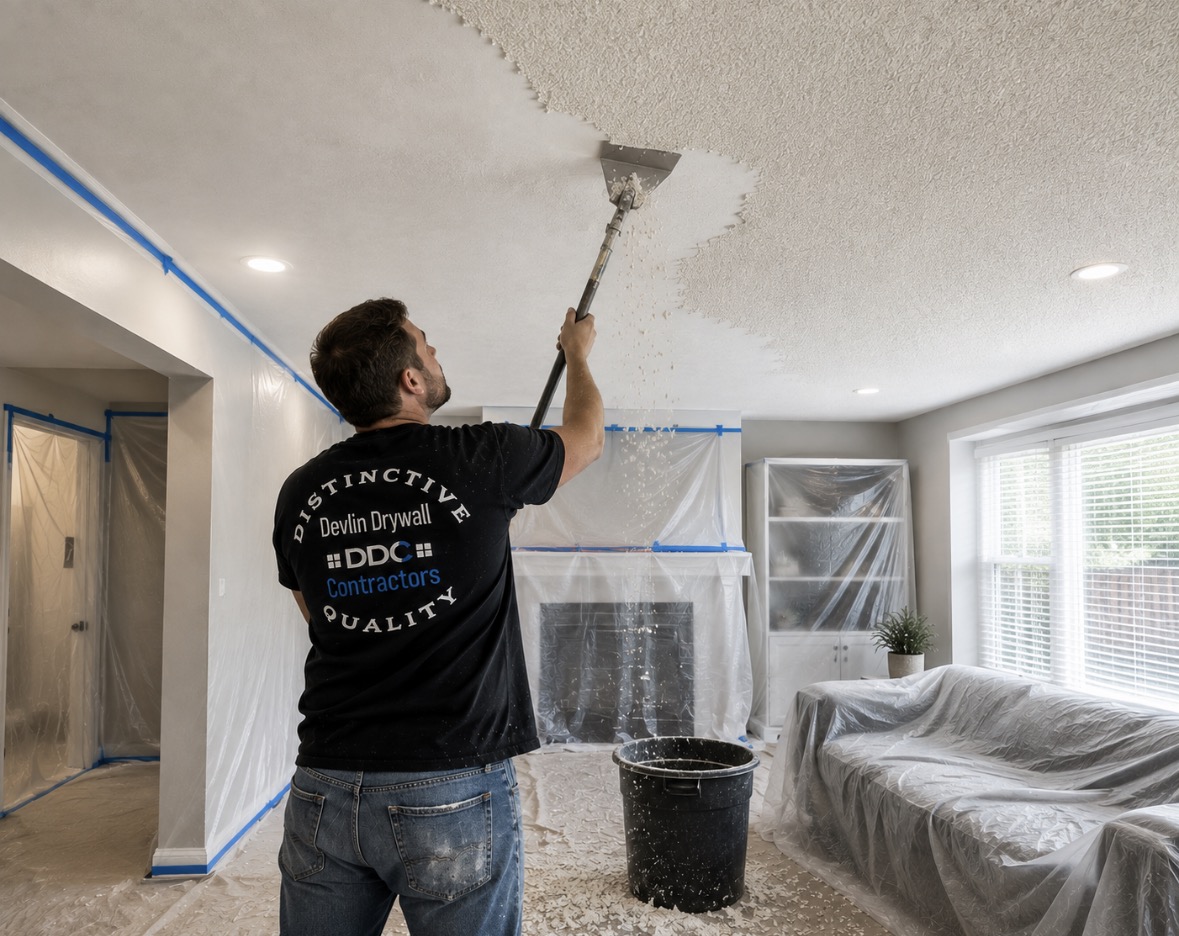
Popcorn Removal
Transform dated popcorn ceilings into clean, modern surfaces. Depending on the age and condition of your ceiling, we'll recommend the right approach, skimming, removal or boarding over, to give you a beautiful finish built to last.
Call Us 604-309-8317Professional Popcorn Ceiling Removal & Modernization
Few changes can update the look of an older home quite like getting rid of popcorn ceilings.
A ceiling that once made a room feel dated, dark or busy can become clean, bright and modern, often changing the appearance of the entire space.
But there's something we think every homeowner should understand:
There isn't one right way to get rid of every popcorn ceiling.
Depending on the age of your home, the type and thickness of the texture, the condition of the drywall underneath and how well the existing materials are still bonded, we may recommend one of three approaches:
Skim coating over the existing texture, removing the texture, or installing new drywall over the existing ceiling.
At Devlin Drywall, we're not interested in recommending the same solution to every customer simply because it's the easiest one to sell.
We want to look at your ceiling, explain what we see, discuss the advantages and risks of each option, and help you make an informed decision.
Sometimes, We Don't Need to Scrape the Popcorn at All
This surprises a lot of homeowners.
On many newer ceilings, often around 30 years old or newer, where the existing texture isn't excessively thick or heavy and is still firmly bonded, we may be able to skim coat directly over the existing texture rather than scraping it off.
This can be a fantastic option.
Instead of wetting, scraping and removing all of the existing texture, we apply drywall compound over the ceiling and progressively create a new smooth surface.
When the existing ceiling is a suitable candidate, this process can be:
Cleaner. Faster. Less disruptive. And extremely effective.
There is significantly less texture debris to remove, and we're able to concentrate our efforts on creating the new finished surface.
But there's an important condition:
The ceiling underneath our new work needs to be sound.
Putting beautiful new drywall finishing over a failing surface doesn't fix the failing surface underneath it.
And this becomes especially important as homes get older.
Why We're More Cautious With 30 to 35+ Year-Old Ceilings
After working on older homes for many years, we've seen the same problem enough times that we believe homeowners deserve to understand it before deciding how they want to proceed.
As ceilings age, we're not only concerned about the popcorn texture.
We're concerned about everything underneath it.
The texture is bonded to the existing ceiling. The drywall joints underneath were originally finished using drywall tape embedded in joint compound. All of those materials have been sitting overhead for decades.
Age, previous moisture exposure, humidity, movement, previous repairs and the original installation can all affect how well those materials remain bonded.
Then we come along and introduce new wet drywall compound, primer and paint to a ceiling that may have remained relatively undisturbed for 30, 35 or 40+ years.
That's where problems can sometimes begin.
Think of an Envelope
There's a simple comparison we often use when explaining this to homeowners.
Think about a paper envelope.
When it's dry, everything can appear perfectly fine. The paper is together, the glued seams are holding, and you might assume it's still strong.
But introduce moisture to that adhesive and things can change.
The seam can soften.
The glue can release.
And pieces that appeared perfectly secure while dry can begin coming apart.
An older drywall ceiling can sometimes behave in a similar way.
It may look perfectly stable when we arrive. But once new wet materials are introduced during the refinishing and painting process, weaknesses in the old system can reveal themselves.
This doesn't mean every older ceiling is going to fail.
It means the risk is higher, and we believe you deserve to know about that risk before we cover everything up.
There Are Actually Two Different Adhesion Concerns
When we assess an older popcorn ceiling, there are two separate existing systems we're thinking about.
1. The Existing Texture
The first is the bond between the popcorn texture and the ceiling underneath it.
If that bond has deteriorated, applying new wet compound or paint over the texture can potentially soften or stress an already weak layer.
The new finish might be perfectly bonded to the old texture, but if the old texture itself releases from the drywall, everything attached to it can come with it.
That's why simply saying, “We'll mud over it,” isn't always enough.
We need to consider what we're actually bonding our new work to.
2. The Original Drywall Tape
The second concern is something homeowners usually can't see at all.
Underneath the texture are the original drywall joints.
Those joints were taped and finished when the home was originally built.
And here's the important part:
Scraping the popcorn texture off doesn't replace those old drywall tapes.
The tape is embedded in drywall compound within the joints and bevels of the original drywall sheets.
So we can remove the visible texture and prepare the surface, but the original taped joints are still part of that ceiling.
If an old tape joint has lost adhesion or is beginning to fail, it can eventually crack, bubble or separate.
That's one of the reasons we become increasingly cautious about relying on the original ceiling system in older homes.
Why We Often Recommend Boarding Over Older Ceilings
Once a ceiling gets into roughly the 30 to 35+ year range, our recommendation will often be to consider installing new drywall over the existing ceiling rather than relying entirely on the old surface.
This is based on what we've repeatedly encountered while working on older homes.
Boarding over gives us something the other methods can't:
A new drywall surface and a new finishing system.
New drywall is mechanically fastened through the existing ceiling and into the framing above. We then install new tape, new drywall compound and create a completely new finished surface.
We're no longer asking decades-old texture or old taped joints to become the foundation for your newly renovated ceiling.
That is why, when we're dealing with an older ceiling and the homeowner wants the option we feel most comfortable recommending for long-term reliability, boarding over is often our preferred approach.
It costs more than simply skimming over an existing texture.
But you're paying for something fundamentally different.
You're getting a new ceiling surface rather than refinishing the old one.
What If I Don't Want to Board Over?
That's completely understandable.
Our job is to recommend what we believe is the best approach.
The final decision is yours.
There are situations where a homeowner may be renovating on a tighter budget, preparing a property for sale, or simply decide that they're comfortable accepting some additional risk in exchange for a lower-cost solution.
We respect that.
If we believe boarding over is the better option but you would prefer us to scrape or skim the existing ceiling instead, we'll explain what concerns we have and what could potentially happen.
The important thing to us is that you're making that decision with the information in front of you.
We never want to recommend the less expensive option without explaining that an older underlying tape or texture bond may still fail later.
If you understand that and decide the lower-cost approach makes more sense for your situation, that's ultimately your choice.
We'll give you our recommendation. We'll explain why. Then we'll let you decide what's right for your home and budget.
Three Ceilings Can Mean Three Different Solutions
This is why we don't believe popcorn ceiling removal should be treated as a one-size-fits-all service.
A relatively newer home with light, firmly bonded texture may be an excellent candidate for skimming directly over the existing texture.
Another ceiling may be better suited to scraping the existing texture, repairing and preparing the drywall, and then refinishing it.
An older ceiling where we're concerned about the condition of the original texture and taped joints may be better suited to new drywall installed over the existing ceiling.
The cheapest method isn't automatically the best method.
And the most expensive method isn't automatically necessary either.
The right solution depends on what's above your head.
That's why we assess the ceiling first.
From Popcorn to a Finished Ceiling, One Team
Whichever method makes sense for your home, Devlin Drywall can take care of the entire transformation.
Our team provides drywall boarding, drywall finishing, ceiling repairs, texture work and interior painting.
That means you don't need one contractor to remove the popcorn, another to repair the ceiling, another to finish it and another company to paint it.
We can take the ceiling from its existing condition all the way through to the finished product.
And because we're responsible for the different stages, we're looking ahead to the final result from the beginning.
Our painters aren't there to hide drywall problems with paint.
If something needs additional attention, we want to address it before the paint goes on.
One team. One standard. One company responsible for the finished result.
What About Asbestos?
Before any older ceiling is disturbed, asbestos needs to be considered.
In British Columbia, asbestos was used in many building materials, including textured ceiling coatings and drywall joint compounds.
That's important because we're not only concerned about the popcorn texture itself, the drywall finishing materials underneath can also be a concern in older homes.
Depending on the age of the home and the work being performed, appropriate testing may be required before we can disturb those materials.
We take this seriously.
We're never going to compromise the safety of our customers or our workers just to get a project started sooner.
If testing is required, we'll explain that before proceeding with work that could disturb potentially asbestos-containing material.
Experience Helps Us Know What We're Looking At
Anyone can look at a popcorn ceiling and say:
"We can cover that."
Experience teaches you to ask another question:
"What are we relying on underneath?"
That's an important distinction.
Devlin Drywall has been serving homeowners since 2006, and over the years we've worked on a lot of ceilings.
We've seen what happens when old texture releases.
We've seen old tapes crack and separate.
We've seen ceilings that looked perfectly fine until renovation work exposed problems underneath.
And we've also seen ceilings where the existing surface is in great condition and there is absolutely no reason to recommend a more expensive solution.
That experience helps us determine what we're comfortable recommending.
With over 270 five-star reviews and counting, we've built our reputation by trying to give homeowners the information we'd want someone to give us if it were our own home.
Sometimes that means recommending the more involved solution.
Sometimes it means telling you that you don't need it.
Ready to Say Goodbye to Your Popcorn Ceilings?
If you've been looking at those ceilings for years thinking,
“One day we're going to get rid of those…”
we'd be happy to help.
We'll look at the age and condition of your ceiling, talk about what you're hoping to achieve, and explain which approach we recommend.
If skimming over it makes sense, we'll tell you.
If scraping makes sense, we'll tell you.
And if we believe installing new drywall over the existing ceiling is the better long-term investment, we'll explain exactly why we're recommending it.
Then you can make an informed decision that works for your home, your expectations and your budget.
Because our goal isn't simply to make an old popcorn ceiling disappear.
It's to help you choose the right way to create the new ceiling that's going to replace it.
Leave the Dusty Work to Us.
Still looking for help?
Tell us a little about what you need help with and, if you can, send us a few photos or a video. No pressure. No obligation. Just friendly, straight forward advice from an experienced team.