
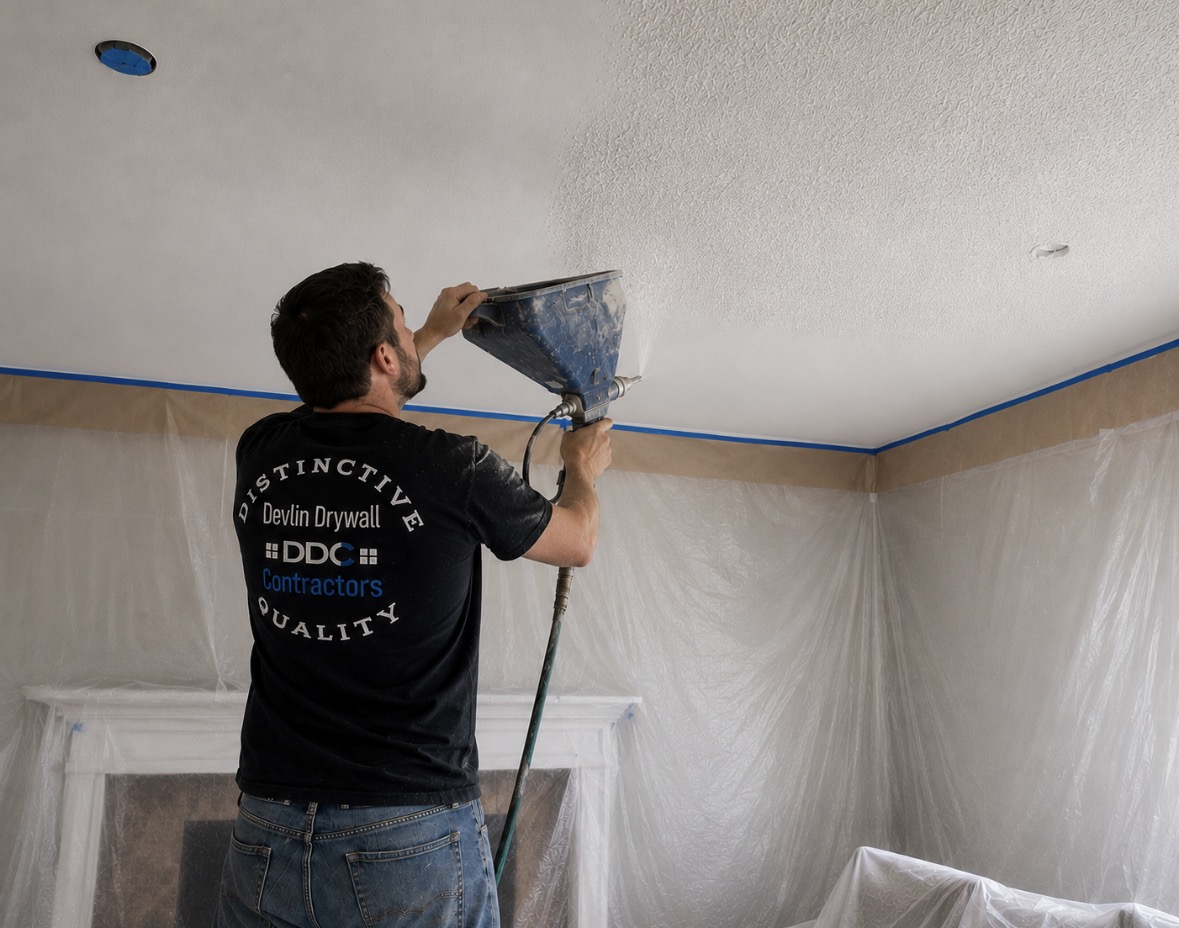
Texture Blending
A great ceiling repair shouldn't draw your eye. We carefully match and blend new texture into your existing ceiling, recreating the pattern, density and appearance as closely as possible so your repair naturally disappears into the surrounding area.
Call Us 604-309-8317Professional Ceiling Texture Blending
A drywall patch might only be a few inches wide.
But if the texture doesn't match, that small repair can suddenly become the first thing you notice every time you walk into the room.
That's where texture blending comes in.
At Devlin Drywall, we specialize in matching new ceiling texture into existing textured ceilings after drywall repairs, plumbing work, electrical work, water damage, renovations and other alterations.
The goal sounds simple:
Make the repaired area blend naturally into the ceiling around it.
Actually achieving that result is anything but simple.
Texture blending is part technique, part experience and, in many ways, part art.
Every existing ceiling is a little different. The texture may have been applied decades ago. It may have been painted several times. The original applicator may have used different material, equipment, pressure or technique than what is commonly used today.
That's why successful texture blending isn't about simply spraying texture onto a patch.
It's about studying what's already there and figuring out how to recreate it.
The Patch Is Only Half the Repair
Let's say a plumber needs to open a section of your ceiling to access a pipe.
The plumbing gets repaired.
New drywall is installed.
The patch is taped, finished and sanded perfectly smooth.
Technically, the drywall repair is complete.
But there's one problem.
You now have a smooth patch surrounded by a textured ceiling.
And if someone simply sprays texture directly onto that little rectangular patch, there's a good chance you'll still be able to see exactly where the repair was made.
That's because a good texture repair isn't just about matching the texture inside the patch.
We also need to think about how the new texture transitions into the existing ceiling around it.
That's the blend.
And in many cases, that's what separates a professional texture repair from a patch that looks like a patch.
Texture Blending Is More Than Pointing a Hopper at the Ceiling
Matching texture involves several variables.
We look at things like the size of the texture, pattern, density, thickness, spacing and overall appearance of the existing ceiling.
Then we adjust our material, equipment and application technique to try to recreate it.
Depending on the existing texture, adjustments can be made to things such as material consistency, air pressure, nozzle size, distance from the ceiling and application pattern.
Small changes can create noticeably different results.
Too much material and the repair can look heavier than the surrounding ceiling.
Too little and it can look sparse.
The pattern can be too large.
Too small.
Too uniform.
Or simply look like new texture sitting in the middle of an older ceiling.
An experienced texture technician learns how these different variables interact.
That's why texture blending is a specialized skill of its own.
We Don't Just Texture the Patch
This is one of the most important things for homeowners to understand.
If your drywall repair is two feet wide, that doesn't necessarily mean we're only going to texture a two-foot area.
In many situations, doing that would actually make the repair more noticeable.
Instead, we'll work beyond the repaired area and gradually blend the new texture into the existing texture.
Think about trying to blend two paint colours together.
If you create a hard line where one stops and the other begins, your eye immediately finds the transition.
But if the transition happens gradually over a larger area, it becomes much harder for your eye to determine exactly where one ends and the other begins.
Texture blending works on a similar principle.
We want to break up the edges of the repair.
Rather than creating a clearly defined new textured area, we work the texture outward into the surrounding ceiling so the transition feels more natural.
How far we need to blend depends on the ceiling, the repair and the existing texture.
Every job is a little different.
The Drywall Finishing Underneath Matters Just as Much
We can create a beautiful texture match, but if the drywall patch underneath isn't finished properly, the repair may still show.
This is something we explain regularly.
Texture can help disguise minor variations, but it isn't a substitute for proper drywall finishing.
A poorly finished joint, hump, ridge or uneven patch can become especially noticeable when light travels across the ceiling.
That's why the repair needs to be properly prepared before texture is applied.
At Devlin Drywall, we can take care of the process from the drywall repair through finishing and texture blending.
That allows our texture technician to work from a properly prepared surface rather than being expected to hide someone else's poor finishing with texture.
The better the foundation, the better our chances of creating a great blend.
Can You Make the Repair Completely Invisible?
We think homeowners deserve a truthful answer.
Sometimes we can get incredibly close.
We've completed texture repairs where, once everything is finished and painted, you'd have a very difficult time finding the original repair.
But we don't believe in promising that every texture repair will become 100% invisible.
There are simply too many variables.
The existing texture may be 10, 20, 30 or 40 years old.
It may have been painted several times.
The original material may no longer exist.
The ceiling may have faded or changed colour.
There may already be inconsistencies throughout the original texture.
And lighting can dramatically affect what you see.
Natural light travelling sideways across a ceiling can expose differences that are virtually impossible to see under normal lighting.
That's why our promise isn't:
“You'll never know there was a repair.”
Our promise is that we'll use our experience to match and blend the existing texture as closely as reasonably possible, and we'll be upfront with you about what kind of result we expect before we begin.
We'd rather set realistic expectations and exceed them than promise perfection where perfection may not be possible.
Not All Ceiling Textures Are the Same
When people hear “textured ceiling,” popcorn is often the first thing that comes to mind.
But there are many different ceiling textures and variations within those textures.
Even two ceilings that appear similar at first glance can have very different patterns when you look closely.
That's why we don't approach every repair using the same material and equipment settings.
We first need to look at what we're matching.
What kind of texture is it?
How heavy was it applied?
How large are the particles or droplets?
How dense is the pattern?
Has it been painted?
How does the surrounding ceiling look?
Then we determine the best approach for recreating it.
It's one of those trades where experience becomes extremely valuable because you've seen so many different ceilings before.
Plumbing, Electrical & Renovation Repairs
Texture blending is particularly useful after other trades have needed access through a ceiling.
Plumbers may need to open drywall to repair pipes or complete a repipe.
Electricians may need access for wiring, lighting or electrical upgrades.
HVAC contractors may need openings for mechanical work.
Renovations can involve moving walls, changing lighting or modifying existing ceiling layouts.
The opening might have been necessary.
But that doesn't mean you should have to stare at it forever.
Once the other work is complete, we can repair the drywall, finish the affected area and blend the texture back into the surrounding ceiling.
This is also why we frequently work with homeowners, plumbers, restoration companies, renovation contractors and other trades who need someone to take care of the finishing work after the repair is complete.
They make the opening.
We make it look like it belongs there again.
Protection Is a Big Part of Texture Work
Texture spraying can be messy.
And unlike working on a wall, we're spraying material overhead.
So before we start spraying, we take the time to properly prepare and protect the surrounding work area.
Depending on the project, this can include protecting floors, walls, furniture and other surfaces and creating containment around the work area.
We don't view this as something separate from the job.
It's part of doing the job properly.
A beautiful texture repair isn't much of a success if the rest of the room is covered in overspray.
We want to come into your home, complete the work professionally and leave the space as clean and organized as reasonably possible.
After all:
Leave the Dusty Work to Us.
Texture, Drywall Repair & Painting, One Team
Texture blending often sits right in the middle of several different trades.
First there's the drywall repair.
Then finishing.
Then texture.
And depending on the project, the ceiling may need to be primed and painted afterward.
Devlin Drywall can handle all of those stages.
That means you don't necessarily need to coordinate one person to patch the drywall, someone else to finish it, a texture specialist to spray it and then a painter to complete the ceiling.
We can take responsibility for the repair from beginning to end.
That's especially important with texture blending because every stage affects the next.
Our drywall finisher understands what surface our texture technician needs.
Our texture technician understands what the painter needs.
And our painter understands that paint isn't there to hide problems underneath it.
If something needs attention, we want to address it at the appropriate stage.
One team. One standard. One company responsible for the finished result.
Sometimes Blending Isn't the Best Solution
We also believe part of being a professional is knowing when not to recommend a particular service.
There are situations where attempting to blend a small area may not provide the result a homeowner is hoping for.
Maybe there are multiple repairs throughout the ceiling.
Maybe the existing texture is already inconsistent or failing.
Maybe previous repairs are visible everywhere.
Or perhaps you're already thinking about modernizing the room and getting rid of the texture altogether.
In those situations, we'll tell you.
It may make more sense to retexture a larger area, smooth the entire ceiling or consider another ceiling solution rather than continuing to make individual repairs.
Our goal isn't simply to sell you a texture blend.
Our goal is to help you choose the solution that will give you the result you're actually looking for.
Experience Makes the Difference
Texture blending is one of those services where the finished product can look effortless.
That's usually because the person doing it has spent years learning how to make it look effortless.
Devlin Drywall has been serving homeowners since 2006, and over the years we've repaired and blended a lot of textured ceilings.
We've seen different textures, different ages of homes, different repairs and plenty of ceilings that presented their own unique challenges.
That experience helps us know what to look for before we start.
And with over 270 five-star reviews and growing, we're proud that so many homeowners have trusted us to complete work inside their homes.
We take that trust seriously.
Have a Ceiling Repair That Needs to Disappear?
Maybe a plumber cut an opening.
Maybe you had a leak.
Maybe an electrician moved some lights.
Maybe you've completed a renovation.
Or maybe there's simply an old repair in your ceiling that's been bothering you every time you look up.
Send us some information about the repair and let us take a look.
We'll assess the existing texture, explain what we believe can realistically be achieved and recommend the best approach.
Because fixing the drywall is only part of the job.
The real goal is making the repair belong in the room again.
And that's exactly what professional texture blending is designed to do.
Leave the Dusty Work to Us.
Still looking for help?
Tell us a little about what you need help with and, if you can, send us a few photos or a video. No pressure. No obligation. Just friendly, straight forward advice from an experienced team.